Screenplay, Story Structure: 188+ stage Hero's Journey, New Self, Detachment...

Advanced Productivity

Creativity Management


The Hero's Journey pattern (also known as the Monomyth) is the template upon which the vast majority of successful stories and Hollywood blockbusters are based upon. Our detailed deconstruction of hundreds of successful stories and Hollywood blockbusters has revealed more than 188 stages of the Hero's Journey that you need to know about...


"...so to roll out successful stories and screenplays, superimpose your situation over this 188+ stage structure."

"...what you're doing is using the structure to pull the hero through his (or her) journey..."

"...it is the pulling through the journey that induces the hero's transformation......a story is transformation..."

"...by pulling your hero through this journey, you cause him (or her) to detach from the Ordinary World and Ordinary Self and attach to the New World and New Self. And then to detach from the New World and New Self and become the Master of Two Worlds and Selves..."

"...this structure is the process of transformation. There is a psychological journey that is mirrored by a physical journey. That is why you often see darkness, rain, thunder and lightning during the stage of the Near Death Experience, for example. By pulling the hero through a physical experience, you are stimulating a psychological transformation. In the beginning the hero will be dressed one way, after being pushed through some stages of the journey, the psychological change will reflect in clothing, behaviour, attitudes and beliefs."

"...it is the undergoing of the journey that provides the hero with the capacity to conquer those challenges that were previously unconquerable..."


Advantages of attaining a truly deep understanding of the Hero's Journey, Transformation and Detachment and Attachment include...


You learn to write stories quickly and effectively. You don't waste months trying to figure out what to do. If you work in TV, you'll be asked to produce effective stories very quickly - within a week, for example. You get the ability to quickly produce many first draft screenplays and then decide which stories you like and which ones you want to work further with and which ones you want to sell.

A script editor or agent may say "we are seeking this type of story." You will be able to quickly write it and sell them it. Or you may think that the next academy award winner is going to be "Brokeback Mountain in the Superbowl." You will be able to write the first draft of a story like that quickly.


Understanding this template is a priority for screen and story writers.
 

Buy the Complete Hero's Journey...more than 188 stages of the journey you need to know about...

Download latest, free sample file (zipped Adobe PDF file)

Join our mailing list - lots of great tips of the day


The Hero's Journey and Transformation

The Hero's Journey is the template upon which the vast majority of successful stories and Hollywood blockbusters are based upon. In fact, we have not come across a [Hollywood] story that does not conform to this template, though there are slight differences between pre and post [around] 1950 output. Understanding this template is a priority for story or screenwriters.

Our 188+ stage Hero's Journey:

Taps into unconscious expectations the audience has regarding what a story is and how it should be told. You subconsciously revert to this template when you differentiate between good and bad stories.

Lays out the universal structural template upon which situations are superimposed. The movies you have seen may look different, but they are all constructed, almost sequence by sequence, in exactly the same way. They are simply alternate situations superimposed over the same structure. This is far more involved than simply three or four acts, plot points, mid point and so on.

Gives you a tangible process for building and releasing dissonance (establishing and achieving catharsis, of which there are usually three, four or more).

Tells you what to write. For example, at a certain stage of the story, the focus should be on moving your Hero from the Deep Ordinary World to the Edge of the Ordinary World.

Lays out the movement between Worlds. There is a difference between the Deep Ordinary World, Edge of the Ordinary World, New World, Deep New World etc.

Lays out the process of Transformation. The function of the Journey is to induce a Transformation.

Lays out the Process of Detachment and Attachment. Every Hero goes through the process of detachment from the Ordinary World and Ordinary Self and attachment to the New World and New Self and then further.

Lays out the process of confrontation and conquest of the Four Core Challenges in the correct order. The Four Core Challenges are separate and distinct from the Multiple Catharses.

Lays out the process of Adaptation in the New World. It is enlightening to regard the development within the New World as adaptation.

Helps you understand the terminology and metaphors. The Hero's Journey is a root fairytale (do not be misled by the term "fairytale"; this does not mean that it only applies to fairytale type stories - this template is universal and applies to the most gritty, down to earth stories you may think of. See the latest, free sample file (zipped Adobe PDF file)).

Provides you with effective worksheets that allow you to quickly extrapolate an idea into a step outline to i) see if it has traction, ii) keep a record of it and iii) develop it before committing to a words-on-paper first draft. Once you understand the 188+ stage Hero's Journey, it is simply a matter of superimposing your situation over the worksheet or template structure.


Buy the Complete Hero's Journey...more than 188 stages of the journey you need to know about...

Download latest, free sample file (zipped Adobe PDF file)

Join our mailing list - lots of great tips of the day


Note: All documents are either Adobe PDF or zipped Adobe PDF. How do I open the files? You need to download Adobe Reader (free) from adobe.com. When zipped, you need to unzip them with winzip (free) from winzip.com first (XP has a built in unzipper).


Table of Contents (of this web page)

Hero's Journey
Hero Archetypes
Heroine's Journey

Inciting Incident
Ordinary World
Call to Adventure
Interdiction / Refusal of the Call
Supernatural Aid
First Threshold
Belly of the Whale
Physical Separation
Transformation Mentor
Trials, Transformation and The Great Cave Complex
Meeting the Oracle and Ideal
Divergence
Journey to the Sword
Seizing the Sword
Night Sea Journey
Death or Near Death Experience
Rebirth
Convergence
Shape Shifter Revealed and The Red Herring
Atonement with the Father
Apotheosis
Ultimate Boon
Disgust and Refusal of the Return
Magic Flight
Rescue from Without
Crossing the Return Threshold
Final Conflict
Master of the Two Worlds
Freedom to Live
AfterLife Act

Archetypes
Who or What is the Hero?
What is a [Hollywood] Story?
Screenplays versus Novels
Good Ideas for Stories
Chicken or the Egg / Story or Hero's Journey
Four Core Challenges
Plots
Multiple Final Catharses
Transformation Cycle and Numbers [3,4,5,7]

Testimonials
Improve your Creativity
Creativity and Time Pressure
The Value of Structure


Deconstructed Films, Stories, Movies, Sitcoms

Readme:

You get more out of the deconstructions if you watch the films simultaneously.

Below are a few hundred basic, first-draft deconstructions, nevertheless the structural concepts are apparent: there in only one story and that is the pattern of the Complete Hero's Journey...more than 188 stages of the journey you need to know about...

The deconstructions illustrate a number of points, including: a) the Hero's Journey fit, b) the rigid structure that all stories conform to and c) the diversity and novelty that can be derived from a core template. Further, the deconstructions significantly enhance our insight into the Hero's Journey.

In all of the deconstructed stories, there is a movement between Worlds. See the free sample file or buy the Complete Hero's Journey..

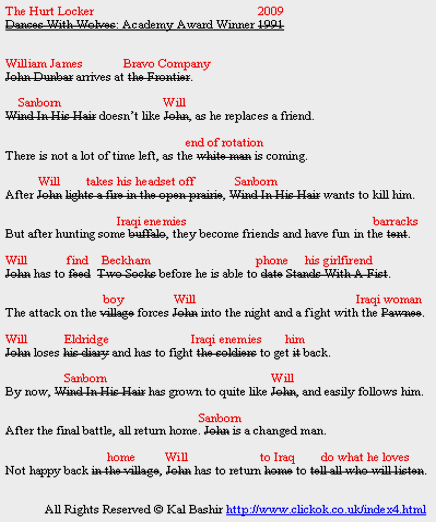
In all of the deconstructed stories, a Transformation occurs. Sometimes the Transformaton is overt (Dances with Wolves, 1990) and sometimes subtle (Jaws, 1975). Transformation occurs, without exception, as a result of passing through [some or all of] the stages of the Complete Hero's Journey...more than 188 stages of the journey you need to know about...

In all of the deconstructed stories, there is detachment and attachment. The Hero detaches from the Ordinary (Old) World and Old Self and attaches to a New World and New Self. Then the Hero moves beyond this to become a Master of Two Worlds and Selves. See the advanced worksheets.

Though the story may not pass through a stage of the Hero's Journey, elements of that stage may be present. For example, it is most common for a Mentor to give the Hero a Magical Gift, however, in The English Patient (Academy Award Winner Best Film, 1996), Hana picks up a necklace [from the ground] at that stage of the Journey; in Gladiator (Academy Award Winner Best Film, 2000), Maximus picks up a statuette [from the mantelpiece] at that stage of the Journey.

Buy the Complete Hero's Journey...more than 188 stages of the journey you need to know about...

Download latest, free sample file (zipped Adobe PDF file)

Join our mailing list - lots of great tips of the day


40 Year Old Virgin (2005)
Alien (1979)
Amadeus (Academy Award Winner Best Film, 1983)
American Beauty (Academy Award Winner Best Film, 1999)
American Splendor (2003)
American Werewolf in London (1981)
Annie Hall (1977)
Back to the Future (1985)
Bagdad Cafe (1987)
Beautiful Mind (Academy Award Winner Best Film, 2001)
Beverly Hills Cop (1984)
Blade Runner (100 Greatest Films, 1982)
Braveheart (Academy Award Winner Best Film, 1995)
Bullitt (1968)
Butch Cassidy and the Sundance Kid (1969)
Capote (2005)
Casablanca (Academy Award Winner Best Film, 1943)
Chicago (Academy Award Winner Best Film, 2002)
Chinatown (1974)
Chopper (2000)
Citizen Kane (100 Greatest Films, 1941)
Color of Money (1986)
Color Purple (1985)
Commando (1985)
Constant Gardener (2005)
Crouching Tiger Hidden Dragon (Academy Award Winner Best Film Nominee, 2000)
Dances with Wolves (Academy Award Winner Best Film, 1990)
Dead Poets Society (Academy Award Nominee Best Film, 1989)
Deer Hunter (Academy Award Winner Best Film, 1978)
Die Hard (1988)
Dirty Dozen (1967)
Dirty Harry (1971)
El Cid (1961)
Elizabethtown (2005)
Empire Strikes Back (100 Greatest Films, 1980)
English Patient (Academy Award Winner Best Film, 1996)
ET - The Extra Terrestrial (100 Greatest Films, 1982)
Failure to Launch (2006)
Fargo (1996)
Fiddler on the Roof (Academy Award Nominee Best Film, 1971)
Fistful of Dynamite (1971)
Forrest Gump (Academy Award Winner Best Film, 1994)
Four Weddings and a Funeral (Academy Award Nominee Best Film, 1994)
From Here to Eternity (Academy Award Winner, 1953)
French Connection (1971)
Get Carter (1971) [the superior English version]
Get Shorty (1995)
Ghandi (Academy Award Winner Best Film, 1982)
Ghostbusters (1984) [Hero's Journey, basic]
Gladiator (Academy Award Winner Best Film, 2000)
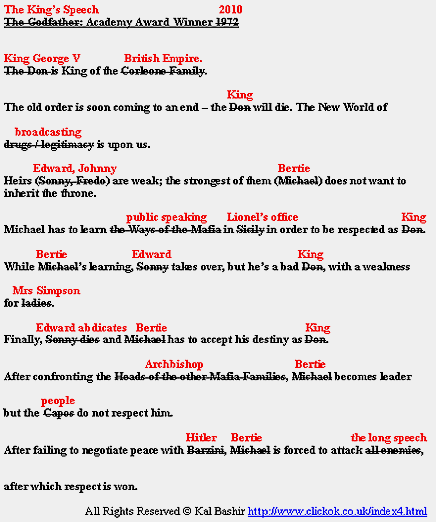
Godfather (Academy Award Winner Best Film, 1972)
Goldfinger (1964)
Good Night and Good Luck (Academy Award Nominee Best Film, 2005)
Good, the Bad and the Ugly (1966)
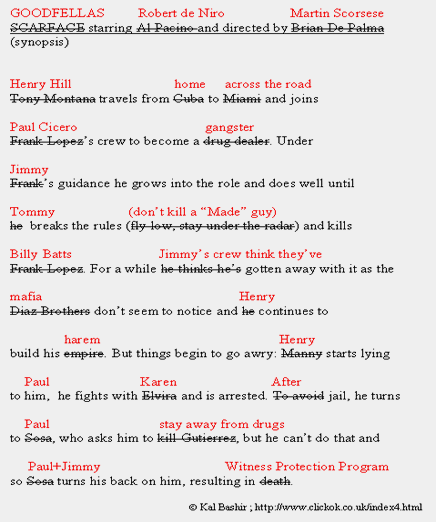
Goodfellas (Academy Award Best Film Nominee, 1990)
Graduate (1967)
Great Escape (1963)
Greatest Story Ever Told (1965)
Groundhog Day (1993)
Harder they Fall (1956)
Harry Potter and the Goblet of Fire (2005)
History of Violence (2005)
Hooper (1978)
Ice Age 2: The Meltdown
Incredibles (2004)
[In the] Heat of the Night (Academy Award Winner Best Film, 1967)
Italian Job (1969)
Jarhead (2005)
Jaws (100 Greatest Films, Academy Award Nominee Best Film, 1975)
Jungle Book (1967)
Jurassic Park (1993)
Kaalia (Bollywood, 1981)
King Kong (2005)
Last Emperor (Academy Award Winner Best Film, 1987)
Lawrence of Arabia (1962)
Lord of the Rings: The Fellowship of the Ring (2001)
Lord of War (2005)
Magnificent Seven (1960)
Manhatten (1979)
Matrix (1999)
Memoirs of a Geisha (2005)
Men in Black (1997)
Midnight Cowboy (Academy Award Winner, 100 Greatest Films, 1969)
Million Dollar Baby (Academy Award Winner Best Film, 2004)
Mission Impossible (1996)
[Chronicles of] Narnia: The Lion, the Witch and the Wardrobe (2005)
Oceans Eleven (2001)
[An] Officer and a Gentleman (1982)
Omen (1976)
Once were Warriors (1994)
One Flew Over The Cuckoos Nest (Academy Award Winner Best Film, 100 Greatest Films, 1975)
On the Waterfront (100 Greatest Films, 1954)
Out of Africa (Academy Award Winner Best Film, 1985)
Papillon (1973)
Planet of the Apes (Greatest Films, 1968)
Platoon (Academy Award Best Film, 1986)
Psycho (1960)
Pulp Fiction (Academy Award Nominee Best Film, 1994)
Raging Bull (Academy Award Best Film Nominee, 1980)
Raiders of the Lost Ark (1981)
Red River (100 Greatest films, 1948)
Rocky (Academy Award Best Film, 1976)
Romancing the Stone (1984)
Scarface (1983)
Shakespeare in Love (Academy Award Winner, Best Film, 1998)
Shawshank Redemption (Academy Award Best Film Nominee, 1994)
Schindler's List (Academy Award Winner Best Film, 1993)
Shine (Academy Award Nominee Best Film, 1996)
Shrek (2001)
Silence of the Lambs (Academy Award Winner Best Film, 1991)
Sleepless in Seattle (1993)
Smokey and the Bandit (1977)
Sound of Music (Academy Award Winner Best Film, 1965)
Spiderman 2 (2004)
Spartacus (1960)
Star Wars (100 Greatest Films, 1977)
Sting (Academy Award Winner Best Film, 1973)
Superman (1978)
Sweet Smell of Success (1957)
Syriana (2005)
Taxi Driver (100 Greatest Films, 1976)
Terms of Endearment (Academy Award Winner Best Film, 1983)
Thelma and Louise (1991)
Third Man (100 Greatest Films, 1949)
Tin Men (1987)
Titanic (Academy Award Winner Best Film, 1997)
Tootsie (Academy Award Nominee Best Film, 1982)
Top Gun (1986)
Trading Places (1983)
Transamerica (2005)
Tsotsi (2005)
Unforgiven (Academy Award Winner Best Film, 1992)
Vertigo (1958)
Walk the Line (2005)
Wall Street (1987)
War of the Worlds (2005)
Wild Bunch (100 Greatest Films, 1969)
Wizard of Oz (Academy Award Best Film Nominee, 1939)
When Harry met Sally (1989)
[It's a] Wonderful Life (Academy Award Nominee Best Film, 100 Greatest Films, 1946)
X-Men (2000)

more...


Sitcom Structure

Various theories differentiate between sitcoms and screenplays / movies. After deconstructing many sitcoms (not all are listed here), we are only comfortable making two statements:

Sitcoms are simply stories told with jokes.

Sitcoms follow the Hero's Journey template. As they are stories, this is not surprising.

Desperate Housewives
My Name is Earl
Shameless
Will and Grace
more...


Buy the Complete Hero's Journey...more than 188 stages of the journey you need to know about...

Download latest, free sample file (zipped Adobe PDF file)

Join our mailing list - lots of great tips of the day


Sitcoms follow the Hero's Journey template too: buy it now


Hero Archetypes

There are various types of Hero: a) the Good, Willing Hero (Star Wars, 1977), b) the Good, Unwilling Hero (Shawshank Redemption, 1994), c) the Anti-Hero or Villain (Raging Bull, 1980; Goodfellas, 1990 etc) and so on.

Nevertheless, their stories all mirror the Hero's Journey template. The difference between Hero, Anti-Hero and other variations simply lies in situation, motivation and result. These are simply Hero Archetypes. See Complete and Advanced Archetypes.


Buy the Complete Hero's Journey...more than 188 stages of the journey you need to know about...

Download latest, free sample file (zipped Adobe PDF file)

Join our mailing list - lots of great tips of the day


Constantly updated with the latest movies and stories: buy it now


Heroine's Journey

It is a mistake to believe that the Heroine's Journey is separate and distinct from the Hero's Journey.

The Journey is about Journey, Transformation, Detachment and Attachment, movement between Worlds, movement from one conscious state to another etc – these are not gender specific:

In Million Dollar Baby (Academy Award Winner Best Film, 2004), though Maggie and Frankie both have their challenges, the process towards apotheosis and beyond is the same.

The Hero is often a female:

Karen in Out of Africa (Academy Award Winner Best Film, 1985)

Clarice in Silence of the Lambs (Academy Award Winner Best Film, 1991)

Thelma and Louise (1991)

Sally in When Harry met Sally (1989)

The Hero and Romantic Challenge roles are often reversed:

In Breakfast at Tiffany's (1961) , Holly is a Hero and Paul is the Romantic Challenge.

In Erin Brockovich (1999) , Erin is the Hero and George is the Romantic Challenge.


Buy the Complete Hero's Journey...more than 188 stages of the journey you need to know about...

Download latest, free sample file (zipped Adobe PDF file)

Join our mailing list - lots of great tips of the day


Insights you simply will not find anywhere else: buy it now


Inciting Incident

Can be separate and distinct from the Call to Adventure. Can be used as a tool to introduce the antagonism, the push-force, develop context, polarisation and more:

In Harry Potter: The Goblet of Fire (2005), we initially meet Voldemort in Harry's dream.

In Shrek (2001), the cartoon characters are being rounded up.

In Star Wars(1977), Vader et al kidnap Leia; we learn about the Empire versus the Rebellion.

Buy the Complete Hero's Journey...more than 188 stages of the journey you need to know about...

Download latest, free sample file (zipped Adobe PDF file)

Join our mailing list - lots of great tips of the day


Screenwriting lecturers use this material! buy it now


Ordinary World and Ordinary Self

Where we learn crucial details about the Hero, his or her True Nature, capabilities and more:

In Gladiator (2000), Maximus takes time to feel the tall grass.

In War of the Worlds (2005), we meet Ray Ferrier at work and at home.

In Annie Hall (1977), Alvie Singer worries about everything in New York.

In Beverly Hills Cop (1984), Axel is a cop in Detroit.

Buy the Complete Hero's Journey...more than 188 stages of the journey you need to know about...

Download latest, free sample file (zipped Adobe PDF file)

Join our mailing list - lots of great tips of the day


There is only one story: buy it now


Call to Adventure

Where the Hero is incited to leave the Ordinary World. Often brought by a Herald; Much happens here:

In Star Wars(1977), R2 relays Leia's message to Luke.

In The Matrix (1999), Trinity tells Neo he is really searching for the Matrix.

In Beverly Hills Cop (1984), Axel is motivated by Mikey's assassination.

In Back to the Future (1985), Doc calls and tells Marty to be at Twin Pines Falls.

Buy the Complete Hero's Journey...more than 188 stages of the journey you need to know about...

Download latest, free sample file (zipped Adobe PDF file)

Join our mailing list - lots of great tips of the day


Allows you to quickly develop treatments and step-outlines: buy it now


Interdiction / Refusal of the Call

Resistances, obstacles, attachments and other issues impede movement out of the Ordinary World. Doves, Interdictors and Interdictions are not uncommon:

In Raiders of the Lost Ark (1981), Marcus warns Indy about the dangers of the Ark.

In The Incredibles (2004), Mr Incredible resists not being allowed to be a superhero. The government, Elastigirl and his boss are Interdictors.

In Get Carter (1971), Carter's boss warns of the northern gangs.

In Gladiator (2000), Maximus does not want to take Marcus Aurelius' place.

Buy the Complete Hero's Journey...more than 188 stages of the journey you need to know about...

Download latest, free sample file (zipped Adobe PDF file)

Join our mailing list - lots of great tips of the day


Helps you write stories and screenplays quickly and easily, so you can choose which one(s) to commit to: buy it now


Supernatural Aid

Magical Mentors and gifts provide guidance and assist the overcoming of hurdles. It is not uncommon for the Hero to encounter multiple Mentors at various stages of the Journey; most commonly there is a Threshold Mentor and a Transformation Mentor.

In Million Dollar Baby (2004), Maggie needs Frankie to start winning.

In The Empire Strikes Back (1980), Luke needs Yoda to tech him the ways of the Force.

In Raging Bull (1980), Vickie lures Jake away from his wife and Ordinary World.

In Gladiator (2000), Marcus Aurelius pushes Maximus forward and Proximo transforms him from soldier to gladiator.

Buy the Complete Hero's Journey...more than 188 stages of the journey you need to know about...

Download latest, free sample file (zipped Adobe PDF file)

Join our mailing list - lots of great tips of the day


Save $$$ on screenwriting courses and books: buy it now


First Threshold

The First Threshold has many functions. This is a place of significant, but not deep, change:

In Lawrence of Arabia (1962), Lawrence gains the king's trust.

In The Matrix (1999), Neo learns martial arts.

In Raging Bull (1980), Jake and Vickie become an item.

In Planet of the Apes (1968), Taylor et al discover this is an ape planet.

Buy the Complete Hero's Journey...more than 188 stages of the journey you need to know about...

Download latest, free sample file (zipped Adobe PDF file)

Join our mailing list - lots of great tips of the day


Get access to the best study of this topic available: buy it now


Belly of the Whale

The Belly of the Whale has many functions. This is a form of Netherworld where the Hero is encouraged to venture into the Deeper New World:

In Dances with Wolves (1990), John Dunbar is resists entering the village.

In Superman (1978), Clarke builds a house in the North Pole and Jor-El teaches him about his history, home planet and Earth.

In The Harder they Fall (1956), this is where Art tells Eddie what he's getting into.

In Thelma and Louise (1991), this is when Thelma takes her time deciding whether to go with Louise or not.

Buy the Complete Hero's Journey...more than 188 stages of the journey you need to know about...

Download latest, free sample file (zipped Adobe PDF file)

Join our mailing list - lots of great tips of the day


You won't need to buy another update, just regularly download from the same location: buy it now


Physical Separation

Where the Hero is (often) forced, pushed or pulled into the Deeper New World:

In Star Wars (1977), Luke et al have to blast their way out of Mos Isley.

In Gladiator (2000), Maximus is taken away by the slave caravan.

In Syriana (2005), Prince Nasir repeatedly calls Bryan.

In King King (2005), Carl forces the ship to leave with Jack on it.

Buy the Complete Hero's Journey...more than 188 stages of the journey you need to know about...

Download latest, free sample file (zipped Adobe PDF file)

Join our mailing list - lots of great tips of the day


More than 188 stages of the Hero's Journey, new insights constantly being appended: buy it now


Transformation Mentor

The Transformation Mentor may be the same or separate and distinct from the Supernatural Aid. One responsibility of the Transformation Mentor is to guide the Hero through the Trials:

In Gladiator (2000), Proximo sees to it that Maximus becomes a Gladiator.

In Memoirs of a Geisha (2005), Mamaha is responsible for Sayuri's transformation into Geisha.

In King Kong (2005), it is King Kong that causes the transformation.

Buy the Complete Hero's Journey...more than 188 stages of the journey you need to know about...

Download latest, free sample file (zipped Adobe PDF file)

Join our mailing list - lots of great tips of the day


Tells you what to write! buy it now


Trials, Transformation and The Great Cave Complex

The Hero, reluctantly or willingly, begins the partial dissolution of the Old Self. A good understanding of this section can carry the screenwriter through the major sections of a screenplay:

In Goodfellas (1990), Karen meets the wives.

In Educating Rita (1983), Rita transforms into a student.

In Al Pacino Scarface (1983), Tony establishes himself as a dope dealer.

In Erin Brockovich (1999), Erin becomes the centre-piece of the case against PG&E.

This stage of the Journey encompasses nine to twelve major parts of the Great Cave Complex. Outer, Middle and Inner Caves represent the three stages of an Initiation - also known as separation, transition, and incorporation or similar. Often four stages may be explicit: separation, transition, incorporation and demonstration.

In The Matrix (1999), Neo's physical growth is a three stage process: first he learns various martial arts through computer simulation, then in hand-to-hand combat with Morpheus and then he undergoes the real-live test (jumping the building).

In Thelma and Louise (1991), Thelma is hit on by Harlan, gets drunk with Harlan, is almost raped by Harlan. Then is shot by Louise.

Buy the Complete Hero's Journey...more than 188 stages of the journey you need to know about...

Download latest, free sample file (zipped Adobe PDF file)

Join our mailing list - lots of great tips of the day


Helps overcome blocks: buy it now


Meeting the Oracle and Ideal

Where the Hero learns of an Ideal, the Sword and the need to seize it.

The Sword is the tangible representation of the Ideal.

The Ideal can (often) be described as altruistic as the Hero will (often) have to disregard his Own Self. Implicit in the Ideal is the concept of sacrifice.

Also see Seizing the Sword

In Carlito's Way (1993), Carlito helps Kleinfeld out of loyalty.

In The Godfather (1972), Michael sees Appollonia.

In Spiderman 2 (2004), the doctor tells Peter Parker that he has a choice.

Buy the Complete Hero's Journey...more than 188 stages of the journey you need to know about...

Download latest, free sample file (zipped Adobe PDF file)

Join our mailing list - lots of great tips of the day


Producers, agents and other decision makers buy this! buy it now


Divergence

Where the Hero is consciously or not, willingly or not, separated from all or many crucial Allies or Enemies, where ideals diverge and more:

In King Kong (2005), Jack leaves everyone behind in order to rescue Ann.

In Star Wars (1977), Luke leaves R2 and C3PO behind.

In Syriana (2005), Bennett goes alone to retrieve the note.

In The Empire Strikes Back (1980), Obi Wan and Yoda cannot help Luke if he goes to rescue Han et al.

Buy the Complete Hero's Journey...more than 188 stages of the journey you need to know about...

Download latest, free sample file (zipped Adobe PDF file)

Join our mailing list - lots of great tips of the day


The ultimate template for all your stories and screenplays: buy it now


Journey to the Sword

Includes obstacles, dangers, foreboding, pessimism, entering a New World and much more:

In King Kong (2005), Jacks journey to Ann is perilous.

In Star Wars (1977), Hans thinks rescuing Leia is suicidal.

In The Lion, the Witch and the Wardrobe (2005), rescuing Edmund involves entering the White Witches lair.

Buy the Complete Hero's Journey...more than 188 stages of the journey you need to know about...

Download latest, free sample file (zipped Adobe PDF file)

Join our mailing list - lots of great tips of the day


Helps you understand and use the symbolism common in the vast majority of stories: buy it now


Seizing the Sword

The Sword is a tangible that represents a number of intangibles and is a significant, but not complete, stage of transformation.

In The Godfather (1972), Michael marries Apollonia and becomes a de facto Sicilian.

In A Fistful of Dynamite (1971), Juan takes out the bridge and becomes a de facto rebel.

In Scarface (1983), Tony takes over Frank's empire and becomes the boss.

Buy the Complete Hero's Journey...more than 188 stages of the journey you need to know about...

Download latest, free sample file (zipped Adobe PDF file)

Join our mailing list - lots of great tips of the day


Helps you understand how to deconstruct stories and screenplays: buy it now


Night Sea Journey

One function of the Night Sea Journey is to attain a Magical Gift from the Old (Another) World,

In Dances with Wolves (1990), John goes back to the fort to dig out the guns.

In Rambo (1984), Rambo steals the truck with the explosives.

In Lord of the Rings: Return of the King (2004), Frodo is saved by the magical vest.

There is much to this stage of the Journey.

Buy the Complete Hero's Journey...more than 188 stages of the journey you need to know about...

Download latest, free sample file (zipped Adobe PDF file)

Join our mailing list - lots of great tips of the day


Helps you understand what a story is (which is not as straight-forward as you may think): buy it now


Near Death Experience

Death is a prelude to Rebirth.

In An Officer and a Gentleman (1982), Worley commits suicide.

In Unforgiven (1992), Clint Eastwood is beaten to a pulp by Gene Hackman.

In A Fistful of Dynamite (1972), Dr. Villega is captured, tortured and forced to reveal the identities of his associates. John recalls his back-story and a similar situation in Ireland. Rod Steiger faces an execution at the hands of a firing squad.

Buy the Complete Hero's Journey...more than 188 stages of the journey you need to know about...

Download latest, free sample file (zipped Adobe PDF file)

Join our mailing list - lots of great tips of the day


Helps you understand the secrets of Transformation, the essence of story: buy it now


Rebirth

Where the complete New Self comes into being.

In Dances with Wolves (1990), John Dunbar wears the complete Sioux uniform.

In The Harder they Fall (1956), Toro now speaks English fluently.

In Syriana (2005), Arash says goodbye to his father and becomes the archetypal suicide bomber.

Buy the Complete Hero's Journey...more than 188 stages of the journey you need to know about...

Download latest, free sample file (zipped Adobe PDF file)

Join our mailing list - lots of great tips of the day


Know more than your competitors, be a thought leader: buy it now


Shape Shifter Revealed and The Red Herring

The Shape Shifter's True Nature may be revealed; where Red Herrings are played out.

In The Incredibles (2004), this is where Mirage helps the Incredible family escape.

In The Lion, the Witch and the Wardrobe (2005), this is where Edmund reveals that he is really wants to be part of the family.

In Syriana (2005), this is where we don't know whether it is Whiting that will be sacrificed.

Buy the Complete Hero's Journey...more than 188 stages of the journey you need to know about...

Download latest, free sample file (zipped Adobe PDF file)

Join our mailing list - lots of great tips of the day


Use this in conjunction with our deconstructions of the latest blockbusters to understand how it is applied: buy it now


Atonement with the Father

There are many aspects of this and it can be interpreted in many ways, one being: an incompatibility (re)surfaces between the New Self and the Old Self.

In Dances with Wolves (1990), John has become a fully fledged Sioux, yet he knows the white man will come and number "as many as the stars."

In Out of Africa (1985), Karen wants Denys not to keep disappearing.

In Casablanca (1943), Victor tells Rick what he would do for Ilsa.

Buy the Complete Hero's Journey...more than 188 stages of the journey you need to know about...

Download latest, free sample file (zipped Adobe PDF file)

Join our mailing list - lots of great tips of the day


Jump, do not walk, up the learning curve: buy it now


Apotheosis

There are many aspects of this and it can be interpreted in many ways. One element of it is the seminal insight , an illumination, an epiphany:

In Casablanca (1943), Rick's insight is that if you love someone, you sacrifice yourself for their happiness. That sacrifice can include selling your most prized material possessions (he sells his bar), allowing your love to find happiness in another's arms (he ultimately allows Ilsa to be with Victor), physical suffering (it is likely that his ultimate actions will see him to a concentration camp), leaving dear friends (he will have to leave Sam behind) and forced exile from home and heart (he will have to leave Casablanca). He learns this insight from both Ilsa and Victor, who are prepared to do the same for each other.

In The Shawshank Redemption (1994), Andy Dufresne's apotheosis is that you either get busy living or you get busy dying. He reaches that insight in the scene by the prison wall with Red (Morgan Freeman), but it is preceeded by the earlier insight that he will never get out of prison (Warden Norton will never let him go).

In Al Pacino Scarface (1983), Tony Montana's insight is that the rewards of the path he's chosen are not worth the spiritual price he is paying, expressed with the words (in the restaurant scene): "is this it? Is that what it's all about Manny? Eating, drinking, fucking, sucking," "no free rides in this world kid," "I lost my appetite," "is that what I worked for? With these hands? Is that what I killed for? For this?"

In Alien (1979), Ripley's apotheosis arrives during the conversation with Ash, the revived android. He tells her that the alien cannot be destroyed and that the military want it - this horror will be unleashed on the Earth unless she destroys it and the only way to do that is to nuke the Nostromo.

In Spiderman 2 (2004), Peter Parker comes to realise the value of being Spiderman and the price he must pay for the gift - give up Mary Jane.

Buy the Complete Hero's Journey...more than 188 stages of the journey you need to know about...

Download latest, free sample file (zipped Adobe PDF file)

Join our mailing list - lots of great tips of the day


Helps you improve quality through prolific production: buy it now


Ultimate Boon

There are many aspects of this and it can be interpreted in many ways. One element of it is synergy:

In The Dirty Dozen (1967), Lee Marvin's challenge is to make his men operate as an effective unit. When Charles Bronson et al attain synergy - they overpower the Major's men in the war games sequence. The whole second act is constructed around the need to reach synergy.

In Beverly Hills Cop (1984), Axel Foley, Taggart, Rosewood and Bogomil finally begin working together to tackle Victor Maitland.

In Alien (1979), Ripley and Parker initially antagonise each other. After their Apotheosis (that the military wants the Alien, it cannot be destroyed and that they are expendable), Parker and Lambert quickly fall into line under Ripley's command.

Buy the Complete Hero's Journey...more than 188 stages of the journey you need to know about...

Download latest, free sample file (zipped Adobe PDF file)

Join our mailing list - lots of great tips of the day


Understand plots and their limitations: buy it now


Disgust and Refusal (of the Return)

There are many aspects of this and it can be interpreted in many ways. One element of it is: refusal to be pushed out of the New World and away from the New Self:

In Dances with Wolves (1990), Stands with a fist refuses to let John go back to the fort to collect his diary.

In Erin Brockovoch (1999), Erin refuses to give up the case to Kirk Potter and his team.

There is also disgust with the New Self:

In Y Tu Mama Tambien (2000), the boys throw up after having slept together.

Buy the Complete Hero's Journey...more than 188 stages of the journey you need to know about...

Download latest, free sample file (zipped Adobe PDF file)

Join our mailing list - lots of great tips of the day


Invest in your craft: buy it now


Magic Flight

This is the physical flight from the New World and New Self and contains an air of the supernatural. Often the Hero is pursued or pursues.

In Raiders of the Lost Ark (1981), Indy swims to the submarine.

In Ali (2000), Ali runs through the village and sees the images of himself.

In Knocked Up (2007), the boys go to Vegas.

Buy the Complete Hero's Journey...more than 188 stages of the journey you need to know about...

Download latest, free sample file (zipped Adobe PDF file)

Join our mailing list - lots of great tips of the day


Don't limit yourself to the limited examples on this site: buy it now


Rescue from Without

The World pulls the Hero back. There are a number of variations, including:

In A Wonderful Life (1946), Clarence rescues and shows George Bailey what the world would have been like without him.

In Spiderman (2000), the Green Goblin kidnaps Mary Jane.

In Thelma and Louise (1991), Hal and the FBI catch up with the girls.

In The Harder they Fall (1956), Eddie persuades Toro to fight until he is paid.

Buy the Complete Hero's Journey...more than 188 stages of the journey you need to know about...

Download latest, free sample file (zipped Adobe PDF file)

Join our mailing list - lots of great tips of the day


Invest in your screenwriting business: buy it now


Crossing of the Return Threshold

Elements include:

Time Pressure. Bond only has so long before the nukes explode.

The Hero will venture to a dangerous place. In Spiderman (2000), the battle takes place high up above the water.

The overwhelming magnitude of the task will be noted. In Star Wars (1977), the Rebellion's fighter pilots are in awe of the Death Star, “look at the size of that thing.”

Buy the Complete Hero's Journey...more than 188 stages of the journey you need to know about...

Download latest, free sample file (zipped Adobe PDF file)

Join our mailing list - lots of great tips of the day


Benefit from the low cost now, we might put the prices up soon: buy it now


Final Conflict

The Final Conflict is so important and contains so many critical aspects that it is astounding that it is rarely given mention. This follows a familiar and similar pattern across genres. It encompasses Multiple Catharses, Impossible Dilemma, Polarization, Unbearable Antagonism, Surpassing Peers, False Heroes, Hand-to-Hand Battle and much more.

In Annie Hall (1977), Alvie confronts Annie.

In Gladiator (2000), Commodus and Maximus battle.

In When Harry met Sally (2007), Harry runs to tell Sally he loves her.

In Die Hard (1988), John takes on Hans.

Buy the Complete Hero's Journey...more than 188 stages of the journey you need to know about...

Download latest, free sample file (zipped Adobe PDF file)

Join our mailing list - lots of great tips of the day


Benefit now and in the future, from the work we put into this: buy it now


Master of the Two Worlds and Selves

There are many aspects of this and it can be interpreted in many ways. One element of it is: The New Self must confront the Old Self.

In The Godfather (1972), Michael tells Kay that he did not kill Carlo.

In Dances with Wolves (1990), John must leave the Sioux to spread the message to anyone who will listen

In Educating Rita (1983), Rita recognises Dr Bryant's contribution to who she is.

Here, the Hero has the ability to traverse both the Worlds.

In The Matrix (1999), Neo can stop and play with the bullets.

In Raiders of the Lost Ark (1981), Indy tries to warn the government of the power of the Ark.

Buy the Complete Hero's Journey...more than 188 stages of the journey you need to know about...

Download latest, free sample file (zipped Adobe PDF file)

Join our mailing list - lots of great tips of the day


Invest to be able to distinguish between truths and misconceptions: buy it now


Freedom to Live

Balance is restored. Quite a good Freedom to Live sequence can be found in Elisabethtown (2005).

In Alien (1979), Ripley relaxes and smiles with Jones the cat.

In Blade Runner (1982), Roy allows the bird to fly free.

In Raging Bull (1980), Jake pours champagne out over a mountain of glasses.

Buy the Complete Hero's Journey...more than 188 stages of the journey you need to know about...

Download latest, free sample file (zipped Adobe PDF file)

Join our mailing list - lots of great tips of the day


If successful writers consistently mirror the same template, then so should you! buy it now


AfterLife Act

Once the Hero has restored balance, his or her story may not end: The Reign, The Fall, the New Journey, The Ascendance, rise to Supernatural Aid or Mentor status, The Death, The Legend, The Rebirth and more all are often appended to the beginning or ending of stories:

In Raging Bull (1980), much happens after Jake retires from Boxing.

In Out of Africa (1985), we learn of Denys' grave, the lions and more.

In Conan the Barbarian (1982), Conan has a particular type of final reign.

Buy the Complete Hero's Journey...more than 188 stages of the journey you need to know about...

Download latest, free sample file (zipped Adobe PDF file)

Join our mailing list - lots of great tips of the day


Learn to look at the films you watch with educated eyes: buy it now


Testimonials

... Thanks very much! This is great stuff!...Michael Traylor

...your book is AWESOME... Cameron McGehee

...I like these templates because they help me quickly develop a treatment, which I can use to find the finance... Lennard Stevenson

...the thing is, you start by using a template to get an idea off the ground in a big way, but then the story develops requirements of its own, so you end up modifying, cutting and pasting and finally creating your own unique structure... Emma Gorman

...the best investigation of story structure I have come across... Nick Wood

...the cheapest and best value screenwriting course... Murray Hughes

... gave me a better understanding of how movies are constructed... Chris Smith

...I won't tell you how long I have been trying to develop a first-draft, but with your templates I managed to do it in a few days... Alan E Farstrup

...before I found your templates, I had to pluck ideas out of thin air. I didn't know what to write next or who should be in the scene and that took forever to figure out.... Rebecca Rowland

... for the hell of it I thought I'd write a screenplay. So I created a folder with a section for each sequence of your template (106). Then I went about filling each section with articles, research etc that related to the story and that section. After a bit of shuffling about the story kind of unfolded in the folder and in my head. When the folder was full I wrote a page for each section. After a bit of cutting and pasting I had an OK words-on-paper first draft. Then I gave it to a few friends to read. They were very kind. After a while of not looking at it I read it again. I saw some things that needed changing, characters that were superfluous, that sort of thing. My third draft was better than my second...anyway, I only ever did it as a fun thing, not a commercial thing...at least I can say I wrote a pretty good screenplay... Ben Cooper

...I use your templates in my screenwriting classes... Sid Hooner

...story structure should be viewed as a form, not a formula... Jeff Archer

...it's amazing how all stories look the same after you have understood the Hero's Journey... Terry Hanser

...I gave up trying to find an agent, now I use your templates to write local stories that I film with my camcorder. Much more fun... Jessica Parker

...Agents started to consider my approaches after I had a bulk of work under my belt, but I've heard of people who got one through personal contacts, schmoozing, networking... Tammy Wright

...I understand now that ideas cannot be copied but structure can... Maggie Hammond

...structure is the key, boy oh boy is it the key... Nicola Tarling

...writing a screenplay is not hard, selling a screenplay is... David Lass

...people don't understand that structure helps produce quality output, they just don't get it... Janice Shriver

... how could people in the creative industries consistently produce quality material without some sort of structure...of course it is the key... Gavin MacDougal

... people think that great stories appear out of thin air, they think you just get inspired, sit down and write War and Peace . But you start with an idea which you map out and develop..and your templates help do exactly that... Kimeta Basha

...it is not usunusal to write ten drafts...what is happening here...the story is being reworked and reworked until it is good. The step outline, treatment and first draft are simply the beginning... Anne Hogben

... you're right, the templates speed up the process but we still have to develop characters, situations and dialogue special to the story... Nancy Etchemendo

...I like the way you use broad terms such as "Time pressure becomes acute" and leave it up to us to write the exact scene... Roselle Angwin

... I find your templates very useful ...Wolfgang Kirchner

... when you take a camera out and come back with an hours worth of rubbish, you realise that you need things to happen. I tried one of your templates (I was cynic) but realised that it gave me a pattern to follow and taught me how to build a story from start to finish and with all the highs and lows incorporated... Marianne O'Conner

...they say you have to write a million words before you write anything good. Your templates help to write those million words quickly... Victoria Williams

...the best way to write a screenply is to go ahead and write a screenplay. But it helps to know where to start. Your template was like being shown the yellow brick road... Seb Mannion

...I honestly think that I would never have written a screenplay without your help.. .Stephen Midlane

...if you analyse the most successful stories of all time, and especially recent Hollywood successes, you notice that they're all more or less variations of the same structure. As you move away from the Hollywood core, there is less rigidity to this structure but also an increase in weirdness and non-commercialism. There are a lot of complex interacting factors like marketing, direction, production values and A-list actors, but you can say that there is a definite relationship between structure and appeal, which is why Hollywood stories seem to have the most widespread appeal.... Katherine Summerhays

...if you analyse say Casablanca , you see that filmmakers knew of the Hero's Journey way before Campbell. So either Campbell is overrated or his significant contribution was simply to make explicit the stages of the journey... Adrian Brink

... not a lot of bucks for a lot of bang... Bradley Hemmings

...one of the biggest leaps a screenwriter can make is to understand the value of structure... Michael Scott

...Structure is one of those things that people will never tell you about or admit to using... Ryan Johnson

...with your templates writing a step outline was a doddle.. John Osborne

...I needed to look at three of your templates to get it. When that Eureka moment came, I thought wow!.... Mike Hodges

... originality is a product of structure ...Ali Lister

...I agree with you when you say that sustained small changes have a large impact over time... Steven Silbiger

...there's this big mystique about how difficult it is to write a first draft. OK, rewriting and rewriting and constantly thinking about your screenplay until it is good can take time, but I wouldn't say it is difficult... Philip Moore

...the fastest way to write a variety of screenplays is through the use of your templates... Nicele Klinger

...it's helpful to think of screenplays as a series of connected sequences as opposed to a story... Louise Holland

...the macrostructure of many stories is essentially the same - it is some variation of the Hero's Journey. But structures differ at the micro level because situations, setups and production values differ... Sal Berry

...I've read about the Hero's Journey from various sources. Your interpretation gave me added insight... Paul Streey

...I use your template to flesh out ideas and don't get started writing the film script until I know exactly what is going to happen at each stage... Sid Harris

...You can't really write a detailed step outline until you've figured out the general outline. That's why the 17-25 step structure is valuable first... Carla Penhalos

...I find I need to do about thirty step outlines before I get it right... Teresa Brown

...collaboration makes the step outline richer... Hal Striker

...a barrier for me is getting past the first fifty or sixty pages. I am really strong in the beginning and then I tail off. Your structures push me through to the end... Josie Power

...you need a character development process alongside your other work... Lette O'Neill

...before you begin the effort of a screenplay, flesh out 10 to 12 stories with the template; that way you can decide which story most truly motivates you... Pauline Kerr

...you need to complete a few film scripts just to convince yourself you can do it. Quality in the beginning is irrelevant. Quality emerges naturally in later scripts... Anne Marie McGuinness

...removing your blocks is like removing layers off an onion... Carol Small

...I don't go for the detailed treatment theory before writing the script...for me mapping the story out to around 25 stages and then writing in screenplay form helps me bring the characters - and therefore their dialogue and actions - to life... Eileen Begley

...you don't necessarily need this structure - any structure helps... Asif Ashraf

..of all the structures you can use, this is the best... Annette McKee

...it doesn't matter whether you believe in the value of structure or not - it is a useful tool and a relevant approach for beginners and experienced hands alike... name withheld

this structure helps you visualise each stage of your story during rereads or rewrites, which can get tedious... Polly Hughes

...without reading the 106 stages, you will never truly understand the Hero's Journey... Avi Garener

...17 or 19 stages just won't do. There are at least 25 - 30 relevant stages to the Hero's Journey... Malcolm Haye

...write a page (including dialogue) for each stage of your structure and then perfect each section... Amy Wack

...just look at Batman Begins, War of the Worlds, Gone in 60 seconds etc : they're the same story.... Kip Sturgeon

...you can write a million stories with your templates... Simon Fowler

...one important rule is to ensure each sequence is of a natural length...what I mean is, don't force a sequence into three pages only because you need to have a sequence that is three pages long... Anne Williamson

...the words-on-paper first draft can be thirty or forty pages long. This allows you to look at a shorter version of your story in it's entirety before expanding... Phil Langley

...it is better to write a shorter, more focused screenplay than to write a longer, unfocused one. A 89 page screenplay can be better than a 119 page one... Nicholas Clee

...I fleshed out four different stories in a single day on the beach using your template... Nora Roberts

...writing screenplays is not as difficult as people think. As yoda said, you must unlearn what you have learned... Tessa Strickland

...ideas for stories are everywhere - just look in the papers - where there is conflict there is a story... Mick McDowell

..the stages of the story structure or Hero's Journey should be viewed metaphorically or symbolically. For example, seizing the sword could be symbolic for acquiring the knowledge the protagonist needs to defeat the antagonist or complete his growth... Annie Small

...it's easier to map a story using 18-25 stages; 106 stages is too dictatorial... Eddie Bell

...you guys know what you're talking about... Helen Dunmore

...a story is what happens, plot is how it happens... John Rogers

... TV and feature writers look at story and characters the same way, it's just that in TV you have a much much longer time to develop and change your characters... Guyot

...the Hero's Journey is your step outline; the story structure templates above are step-outlines... Mark Austin

...These templates don't apply only to features, but also TV; I recently saw an episode of Shameless in the UK where Frank finds the strength to tackle his father after a near death / rebirth experience (his father nearly throws him off a ladder)... Eileen McArthy

... it's important to remember that the Hero's Journey only applies to Acts I and II in the III act structure... J Rifkin

Buy the Complete Hero's Journey...more than 188 stages of the journey you need to know about...

Download latest, free sample file (zipped Adobe PDF file)

Join our mailing list - lots of great tips of the day


Constantly updated with insights from the latest blockbusters and sitcoms: buy it now


Who or What is the Hero?

There are a number of possible answers:

a) The Hero is the person with the most screentime - the person who has the most attention of the camera. There are many excellent films / stories where screentime is shared (When Harry met Sally (1989), Pulp Fiction (1994), Red River (1948) etc). So this answer is not quite satisfactory.

b) The Hero is the person that changes / transforms the most. This is inaccurate. In Back to the Future (1985), George McFly is the person who changes most. In Beverly Hills Cop (1984), Rosewood changes the most, not Axel Foley. This answer excludes mature, developed heroes.

c) The Hero is the person who has his challenges resolved. This is also incorrect as other [rich] characters, notably Loyal Allies, Shape Shifters and Mentors, also have their challenges resolved. In Back to the Future (1985), Doc [the Mentor] also has a challenge: to survive the Libyan terrorists. This is just one example.

d) The Hero is the person who holds true to his / her deepest values. This is incorrect as the Hero's Journey is about Transformation: it is usual, in fact it is common, for the Hero to change his or her deepest beliefs.

e) The Hero is the person that passes through the stages of the Hero's Journey. The Hero does not always passes through [all or some of] the stages of the Hero's Journey (Red River (1948), Pulp Fiction (1994) etc).

f) The Hero is that person with whom we empathise with most. Not necessarily. In Blade Runner (1982), we empathise most with Roy, not Deckard.

g) The Hero is that person who does good, who is most altruistic. This ignores Antiheroes, Unwilling Heroes and other Hero archetypes.

h) The Hero is he or she who makes The Sacrifice. No: Mentors, Shape Shifters commonly make a sacrifice (Obi Wan, Star Wars (1977) etc).

i) The Hero is the Bringer of and Representative of The Changing.This is closer to a truth.

Buy the Complete Hero's Journey...more than 188 stages of the journey you need to know about...

Download latest, free sample file (zipped Adobe PDF file)

Join our mailing list - lots of great tips of the day


Constantly updated with insights from the latest blockbusters and sitcoms: buy it now


What is a [Hollywood] Story?

From the analysis of the above films:

a) In all of the above deconstructed stories, there is a movement between Worlds. As a minimum, there is an Ordinary World and a New World. Domains or states within a World can also be described as "New Worlds." See the free sample file (zipped Adobe PDF file)

b) In all of the above deconstructed stories, a Transformation occurs. Sometimes the Transformation is overt (Dances with Wolves, 1990) and sometimes subtle (Jaws, 1975).

b) Transformation occurs, without exception, as a result of passing through [at least some of] the stages of the Complete Hero's Journey.

c) One or more characters conquer a number of challenges, all of which are framed within the parameters of the Complete Hero's Journey.

d) There is a distinct process of story closure. That is, multiple catharses close a story.

e) There is more: see the Complete Hero's Journey...more than 188 stages of the journey you need to know about...


Buy the Complete Hero's Journey...more than 188 stages of the journey you need to know about...

Download latest, free sample file (zipped Adobe PDF file)

Join our mailing list - lots of great tips of the day


Constantly updated with insights from the latest blockbusters and sitcoms: buy it now


Improve your Creativity

Creativity Management can seriously improve the quality and quantity of your creative output. Ironically, this topic is best understood in the senior business community - businesses continually need to be creative and innovative to maintain competitive advantage and solve a host of other issues. This topic is taken seriously by Harvard, Yale, Princeton et al and studied at the highest academic levels.

Critical insights will help you write better screenplays, for example:

a) The relationship between production and quality: it can be concluded with great confidence that quality of output is closely connected to sheer quantity. Moreover, the single best creative product tends to appear at that point in the career when the creator is being most prolific.

b) Separating creative from critical thinking: writing and editing are separate and distinct processes.

c) Forcing inspiration: screenwriters will often find that their best ideas occur while they are engaged in other projects.

d) Manipulating organisational culture and organisational structure to overcome blocks.

e) Achieving radical leaps through incremental productivity.

f) Avoiding and clarifying misconceptions: what exactly is originality? is there such a thing as a creative type?

Learn more about Creativity Management here....


Screenplays versus Novels

We have no large sample data for this but the anecdotal evidence suggests that many novels also follow the Complete Hero's Journey...more than 188 stages of the journey you need to know about... template. Successful bestseller examples include:

The Kite Runner -- by Khaled Hosseini

The Bookseller of Kabul -- by Asne Seierstad

Harry Potter and the Prisoner of Azkaban (Book 3) -- by J.K. Rowling

Buy the Complete Hero's Journey...more than 188 stages of the journey you need to know about...

Download latest, free sample file (zipped Adobe PDF file)

Join our mailing list - lots of great tips of the day


Constantly updated with insights from the latest blockbusters and sitcoms: buy it now


Good Ideas For Stories

From the analysis of the deconstructions of hundreds of blockbusters:

There is always a movement between Worlds: which Worlds does your Hero traverse?

There is always a Transformation: think of a Transformation as the basis for your story idea. Conduct your Transformation through the process of the Hero's Journey

There is always detachment and attachment: what and who does your Hero detach from and attach too?

There are always a number of challenges. Frame your Journey and Transformation around the conquest of these challenges.

Buy the Complete Hero's Journey...more than 188 stages of the journey you need to know about...

Download latest, free sample file (zipped Adobe PDF file)

Join our mailing list - lots of great tips of the day


Constantly updated with insights from the latest blockbusters and sitcoms: buy it now


Chicken or the Egg / Screenplay or Hero's Journey

The Hero's Journey is, in effect, the dominant and most successful pattern for telling effective stories. This pattern is being developed as stories are produced but also, many stories are produced with it as a template. So what's going on? A number of factors are probably in play, including:

Story and screenwriters are consciously aware of the Hero's Journey and Transformation and model their work around it.

Story and screenwriters study other successful work that is most relevant to their own and ask the right questions: why is the hero on the bus then? Why does that person get shot at that point in the story? Why does the scenery change there? Why does the hero have new clothes at that point? Why do the heroes in five distinctly different movies get submerged underwater at that point? And so on. As a result of this process, the Hero's Journey pattern is mirrored.

Certain dynamic and dramatic techniques make more effective stories. These can be found time and again in screenplays, novels, short stories and so on. Again, as a result, the Hero's Journey pattern is mirrored.

Methods for conveying messages, symbolism, message interpretations etc vary culturally and with time: though the core remains the same, message delivery varies.

Buy the Complete Hero's Journey...more than 188 stages of the journey you need to know about...

Download latest, free sample file (zipped Adobe PDF file)

Join our mailing list - lots of great tips of the day


Constantly updated with insights from the latest blockbusters and sitcoms: buy it now


Creativity and Time Pressure

There are two contrary arguments: a) time pressure stimulates creativity and b) time pressure reduces creativity. Both are true.

There are a number of forces at work:

Time pressure increases creative output. By forcing idea production, setting goals and incremental deadlines, a greater number of ideas are produced than if a “do your best” approach is taken. If a leader asks participants in an idea generating session to address a problem and think of at least 5 ideas every half an hour, then 80 ideas are produced by one individual and 1600 are produced by 20 individuals at the end of an average working day. This level of output is conscious and would not be produced normally.

Time pressure encourages prolific production and therefore the probability of generating good ideas increases. It can be said with great confidence that quality of output is closely related to quantity. The best single creative product tends to appear at that point in the career when the creator is being most prolific.

Forcing output pushes individuals along the experience curve, refines their methodology, builds competencies and knowledge and improves performance. Screenwriters know that they are likely to produce more, better quality work faster if they set themselves a schedule of a certain number of pages per day.

Motivation is critical to creativity. If a person is intrinsically motivated, time pressure may be a synergistic extrinsic motivator. If the person is not intrinsically motivated then it may turn out to be a non-synergistic extrinsic motivator, which reduces the level of engagement in the endeavour.

Short-term time pressure can be negative in that it does not allow the mind to engage in the endeavour at various cognitive levels. It does not allow rich ideas to formulate through the process of incubation. Intrinsically motivated individuals will benefit from short term time pressure and goals (sets cognitive forces in motion) and will generate richer ideas through incubation over the longer term.

Learn more about Creativity Management here....

Buy the Complete Hero's Journey...more than 188 stages of the journey you need to know about...

Download latest, free sample file (zipped Adobe PDF file)

Join our mailing list - lots of great tips of the day


Constantly updated with insights from the latest blockbusters and sitcoms: buy it now


The Value of Structure

Structure, in its many forms, increases the quantity and quality of creative output. The golden rule is that originality emerges from structure:

a) Short term goals (incremental productivity) produce more output than a "do your best" approach. With specific regard to creative writing, writing four pages a day completes a words-on-paper first draft screenplay in one month. A "do your best" or "waiting for inspiration" approach can take months or years. Witness the untold number of people with unfinished manuscripts under their beds.

b) Work processes help to i) unblock the mind, ii) tap into tacit knowledge, iii) trigger the mind into working at various cognitive levels and iv) apply i) and ii) and iii) to the areas of problem identification, idea generation, idea selection, development and commercialisation.

c) Frameworks reduce complex problems into their component intellectual parts. Frameworks increase output by reducing complex problems into smaller, more manageable problem solving exercises. A similar idea is that problems, no matter how daunting, can be solved by breaking them into their constituent parts.

d) Templates, with specific regard to creative writing, are valuable as they are step-outlines. They are ready-made analyses of story structure; by using them writers can quickly expand an idea into a story. Past a critical threshold, the story then begins to dictate its own structure: thus originality emerges from structure.

e) Simply being prolific improves performance and quality. The single best creative product tends to appear at that point in the career when the creator is being most prolific.

f) Simply engaging in the tasks improves performance. Experience refines knowledge and methodology towards optimal levels.

g) Engagement stimulates the mind into working on problems at various cognitive levels and results in inspiration. Screenwriters often find that their best ideas come to them when they are in the middle of writing a screenplay.

h) Structure helps clearly identify complex problems and triggers incubation. Problems incubate until answers become apparent. Incubation tends to result in richer insights.

i) Engagement increases the incidence and frequency of problem identification and thus the incidence and frequency of insight.

j) Engagement (coupled with motivation) increases solution seeking, through active search for stimuli and intellectual cross-pollination through networks, bridging and collaboration.

k) Repeated engagement (coupled with motivation) triggers frame breaking; helps identify path dependencies and parochialism.

l) Radical shifts (novelty, originality) occur through sustained incremental change. By incrementally modifying output, the distance between the original and final versions increases. Radical shifts sometimes result from dramatic events or conditions but the vast number of gains accrue from continuous incremental improvement.

Learn more about Creativity Management here....

Buy the Complete Hero's Journey...more than 188 stages of the journey you need to know about...

Download latest, free sample file (zipped Adobe PDF file)

Join our mailing list - lots of great tips of the day


Constantly updated with insights from the latest blockbusters and sitcoms: buy it now


Four Core Challenges

One or more characters conquer a number of challenges. There are Four Core Challenges: a) the Inner Challenge, b) the Romantic Challenge, c) the Outer Challenge and d) the Greater Antagonism:

In Titanic (Academy Award Winner Best Film 1997; No. 1 All-Time USA Box-office with receipts of over $600,000,000), Rose's Inner Challenge is to overcome her commitment to her mother as well as Jack's lower status, her Romantic Challenge is Jack, her Outer Challenge is Cal and the Greater Antagonism is escaping the sinking ship.

In American Beauty (Academy Award Winner Best Film 1999), Lester Burnham's Inner Challenge is to feel good about himself, his Romantic Challenge is Angela, his Outer Challenge is his marriage with Carolyn and the Greater Antagonism is Col. Frank Fitts, US Marine Core.

In Top Gun (1986, receipts of $176,000,000), Maverick's Romantic Challenge is Charlie, his Inner Challenge is his personal and father's story, his Outer Challenge is getting over Goose's death and the Greater Antagonism is becoming Top Gun.

The Four Core Challenge categories can be viewed as classes:

In Tootsie (Academy Award Nominee Best Film 1982), Michael's Romantic Challenge is Julie, his Inner Challenge is represented by his penultimate line "I was a better man with you as a woman than I ever was with a woman as a man...I just gotta learn to do it without the dress...", his Outer Challenge is Ron [symbol of male condescension] and the Greater Antagonism is his problem that the network and fans thinks he's really a woman. But within the class of the Inner Challenge is Sandy and within the class of the Romantic Challenge are the attentions of Les and Van Horn.

It is common for major characters other than the Hero [most often the Romantic Challenge, Supernatural Aid, Shape Shifter] to have their own challenges:

In Gladiator (Academy Award Winner Best Film, 2000), Proximo and Lucilla both have their own demons to overcome.

Our 188 stage Hero's Journey incorporates the Four Core Challenges; you do not have to figure out how they map onto the Hero's Journey.

Buy the Complete Hero's Journey...more than 188 stages of the journey you need to know about...

Download latest, free sample file (zipped Adobe PDF file)

Join our mailing list - lots of great tips of the day


Constantly updated with insights from the latest blockbusters and sitcoms: buy it now


Plots

There is an argument between the One Story concept [that all stories are structured around the Hero's Journey] versus the concept of "Plots" [that there are, for example, a finite number of basic plots such as Rebirth, Tragedy, Rags to Riches].

The argument is misleading.

It is true that there is only One Story [the Hero's Journey] - you can see this by analysing our deconstructions of hundreds of successful Hollywood stories and analysing our Complete Hero's Journey.

The essence of story is transformation and the process of that transformation, at the root level, is the Hero's Journey. Moving on, there are a finite number of drivers that push (or pull) the transformation forward (for example, sometimes the push is external, sometimes it is internal etc). Each driver (or combination of) produces its own variable (Plot) of the Hero's Journey. For example, if the Hero is willing, there are increased obstacles and interdictions. If the Hero is unwilling, there are increased pushes or pulls forward. Learn more about Plots...

In other words, all "Plots," when deconstructed, can be reduced to the Hero's Journey / Transformation.

Buy the Complete Hero's Journey...more than 188 stages of the journey you need to know about...

Download latest, free sample file (zipped Adobe PDF file)

Join our mailing list - lots of great tips of the day


The Complete Hero's Journey is the frame around which the seven basic plots are structured: buy it now


Transformation Cycle

In many stories it is hard not to recognise the prevalence of sets of numbers. These relate to the stages or cycle of transformation.

The most common number notable is 3 [Goldilocks and the Three Bears; three visits to the giants castle in Jack and the Beanstalk; in The Matrix (1999), Morpheus introduces Neo to the Nebuchadnezzar, then introduces the crew and then shows him the Matrix through the console). Three [The Three Steps] is the most basic path to transformation: initiation, trial and transformation (terminology varies).

Four steps are also common: initiation, trial, transformation and demonstration.

Many effective screenplays utilise Five Steps: In Thelma and Louise (1991), Louise warms Thelma not to flirt with anyone; Thelma flirts with Harlan, Thelma gets drunk with Harlan, Harlan tries to rape Thelma, Louise shoots Harlan.

When you are writing sequences, construct each with 3, 4, 5 steps - at least be conscious of the numbers and the Transformation Cycle.

Transformation can be deconstructed into many more stages and ultimately, very much mirrors the Complete Hero's Journey.

Buy the Complete Hero's Journey...more than 188 stages of the journey you need to know about...

Download latest, free sample file (zipped Adobe PDF file)

Join our mailing list - lots of great tips of the day


The Hero's Journey is The Transformation Cycle: buy it now


Multiple Final Catharses

Stories do not simply end. There is a very distinct process of catharsis release. Successful stories end with three, four or more catharses – these catharses are often separate and distinct from the Four Core Challenges.

In Die Hard (1988), there are many catharses, including: John rescuing his wife, defeating Hans and then Karl. Argyle also has his moment.

In Star Wa